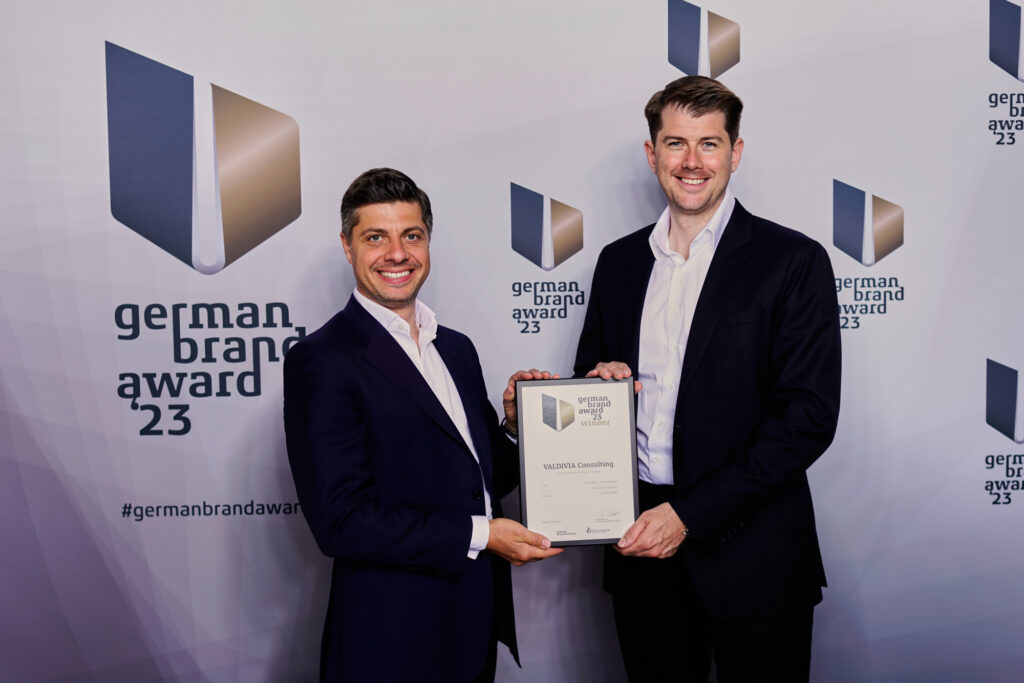
Daniel Bauer, Managing Partner at VALDIVIA, talks to psychologist Dr Stefanie Marx-Fleck about dealing with uncertainty, the human side of leadership responsibility and the question of how good decisions can be made even without certainty.
Uncertainty is part and parcel of everyday business life. Yet rarely has it been as multifaceted and persistently palpable as it is today. In the property sector in particular, leaders face the challenge of making far-reaching decisions, even though economic, political and social developments are becoming increasingly difficult to predict. At the same time, they bear responsibility for companies, investments and, above all, for people.
What does it mean to lead under these conditions? How does uncertainty influence the way we think, feel and act? And what helps leaders to provide guidance, take responsibility and remain capable of acting, even in difficult situations?
These are the questions addressed by psychologist Dr Stefanie Marx-Fleck. She completed her PhD at Goethe University in Frankfurt am Main and conducts research into the psychological effects of uncertainty, human decision-making behaviour, and the importance of leadership and psychological safety within organisations.
Daniel Bauer, Managing Partner at VALDIVIA, sees first-hand in his day-to-day work how the demands placed on leaders in the property sector are changing. In this interview, he combines his practical perspective with Dr Marx-Fleck’s academic insight.
The discussion centres on the challenges of leadership in uncertain times, difficult decisions and their emotional consequences – and on what can help leaders deal constructively with responsibility, doubt and uncertainty.
Daniel Bauer: Dr Marx-Fleck, your academic work focuses intensively on how people deal with uncertainty and make decisions. What originally sparked your interest in this topic?
Dr Stefanie Marx-Fleck: I am interested in how people can make sound and courageous decisions under real-world conditions. The COVID-19 pandemic has made this question very tangible: decisions had to be made whilst the data situation was changing daily and their consequences were difficult (or impossible) to predict. At the same time, it became clear just how strongly the desire for certainty can shape decision-making.
In research, we refer to this as defensive decision-making. By this we mean decisions in which people do not choose the alternative that makes the most sense for the organisation, the patients or even society, but rather the option that is safest for them personally. In this context, we understand safety to mean the avoidance of personal risks, such as criticism, interpersonal conflicts or accusations. Whilst the desire to avoid such personal risks is understandable, it can lead to necessary decisions not being taken. It is important to emphasise here that defensive decision-making is not a matter of individual decision-making incompetence – in other words, the decision-makers do not ‘know any better’ – but rather a context-dependent phenomenon: If, in their day-to-day working lives, people experience that making a mistake or a decision turning out to be wrong in hindsight can lead to negative personal consequences, they are likely to ‘play it safe’ the next time. Studies have shown that between 20 per cent and 50 per cent of all decisions made in an organisational context are defensive (Artinger et al., 2019; Artinger, Marx-Fleck et al., 2025; Gigerenzer, 2014).
Uncertainty seems to be increasingly becoming a constant feature of our economic and social lives. From a psychological perspective, what effect does persistent uncertainty have on us – and, in particular, on people in leadership positions?
Uncertainty can heighten alertness and tension. Over time, it becomes a burden when people no longer feel they have any control and do not know how to guide their actions. Managers experience this particularly keenly because their decisions have consequences for others. This increases the temptation to seek reassurance through further analysis or . Yet more information does not automatically lead to better decisions. What matters is knowing what one knows, what one does not know, and which rules apply to one’s own decision-making. Clarity does not come from a manager predicting everything, but from acting in a way that is transparent and understandable.
Managers in the property sector are often responsible for substantial investments, long-term projects and numerous jobs. How does such a high level of responsibility influence the way they deal with uncertainty? And what helps them to remain capable of making decisions, even under pressure?
A high level of responsibility can lead to making defensive decisions. Whilst this sometimes protects against criticism, it does not necessarily improve the decision itself. It is helpful to establish clear criteria in advance: What must not be jeopardised? What losses are acceptable? What information would actually change the decision? A simple rule can be better than a complicated model if it suits the situation. Furthermore, decisions should be made verifiable: What assumptions underpin them, when will they be reassessed, and how can we tell that we need to change course? In this way, responsibility is not confused with certainty.
Many important decisions have to be made today, even though key information is missing and the potential consequences are difficult to assess. What does psychological research tell us about how people make decisions under these conditions? Are there any insights that can help managers deal with this situation more effectively?
In situations of uncertainty, people resort to mental shortcuts (known as heuristics). A good heuristic can be both quick and robust, particularly when data is incomplete or dynamic. A well-known rule is: if a particular characteristic is especially telling, examine it first; if it allows for a clear decision, there is no need to gather every further detail. Managers should therefore not only ask: ‘Do we have all the information?’, but also: ‘Which information is crucial?’ and ‘Which simple rule applies to this situation?’ It is important to make the rule transparent and to learn from the results. You cannot eliminate every uncertainty, but you can structure decisions in such a way that the reasoning behind them is clear.
Leadership, particularly in difficult times, also means having to make and stand by decisions that have a profound impact on other people’s lives – for example, when staff have to be made redundant. From a psychological perspective, how does such responsibility affect leaders themselves? And what can help them cope with this emotional strain?
A decision that potentially harms other people can take a heavy emotional toll. This burden should neither be dismissed as a weakness nor interpreted as proof that the decision was wrong. It is helpful to examine the reasons openly: What alternatives were there? What consequences were foreseeable? Were those affected treated fairly? Managers should not hide the decision behind figures or procedures, but should take responsibility for it and treat those affected with respect. A discussion with other managers or even professional business coaches can help to examine one’s own perspective. It is crucial to learn from the stress rather than glossing over it with retrospective justifications.
At this point, I always like to refer to the concept of self-compassion from the field of positive psychology. Managers should allow themselves to acknowledge that difficult decisions may also take their toll on them. Self-compassion does not mean downplaying one’s own responsibility or justifying decisions uncritically. Rather, it means being aware of one’s own feelings and limits, treating oneself with the same fairness and goodwill as one treats others, and recognising that even responsible action can be associated with doubt and an emotional toll.
Whilst managers are expected to provide their staff with support and guidance, they themselves are often under considerable pressure. What significance does psychological safety hold for managers personally? How important is it that they, too, have spaces where they can speak openly about their doubts and stresses?
According to Amy Edmondson (1999), psychological safety refers to the shared belief within a team that it is safe to take interpersonal risks – such as asking questions, admitting mistakes, voicing concerns or disagreeing – without having to fear negative interpersonal consequences. Research has particularly emphasised the role of leaders in fostering psychological safety within teams. However, leaders themselves must also feel psychologically safe and need people within the organisation with whom they can take interpersonal risks. Those who ponder difficult decisions alone often see fewer alternatives and only realise their own blind spots later on. A safe space can help to challenge assumptions and assess risks more clearly. This does not mean that every uncertainty must be aired publicly. It means that an organisation allows for dissent and honest questioning.
Managers are often expected to radiate confidence and to remain composed even in difficult situations. At the same time, they themselves experience uncertainty and doubt. How much of their own uncertainty can or should managers show to their teams? And how can they provide guidance without being able to promise certainty?
Managers should not feign a sense of certainty they do not possess. They can clearly state what is known, what remains unclear, and when the situation will be reassessed. This builds more trust than a false promise of certainty. At the same time, a team needs actionable next steps. A manager can therefore acknowledge uncertainty about the outcome whilst still providing clarity on the process: What are the priorities right now? Who makes the decisions? What indicators would trigger a change of course? Direction is provided by reliable criteria and honest communication, not by claiming to know the future.
Uncertainty is often perceived primarily as a burden or a threat. Your research also explores how people experience and assess uncertainty. Is it possible to learn to deal with uncertainty in a more constructive way – and perhaps even develop the ability to recognise new opportunities within it?
Yes. This includes the realisation that uncertainty does not always mean danger. It can also open up scope for new solutions. You can practise this by explicitly stating your assumptions, considering several plausible scenarios and trying out small, reversible steps. In this way, you gain information without committing yourself too early to a major decision that is difficult to reverse . The aim need not be to find uncertainty pleasant. It is to remain capable of making judgements and taking action despite uncertainty.
Dealing with uncertainty is not just an individual matter; it also depends on a company’s culture. What framework conditions should organisations put in place to enable managers and staff to deal with uncertainty openly and constructively?
Organisations should specifically promote the psychological safety discussed above: employees must be able to raise risks, ask questions and voice dissent without being exposed to ridicule. This does not mean that every decision is discussed endlessly. It means that relevant objections are heard before a decision is made. Specific routines help to achieve this: managers can explicitly ask for counter-arguments in meetings, openly address their own uncertainty and mistakes, and have their decisions scrutinised by a ‘critical friend’. After major projects, a brief review can clarify: What did we expect? What actually happened? What can we learn from this? A good culture of learning from mistakes distinguishes between unintentional errors, risky decisions based on uncertain grounds, and deliberate breaches of the rules. Mistakes should not be punished across the board, but analysed. At the same time, responsibilities and consequences remain clear. This reduces the incentive to withhold information or make decisions defensively. Psychological safety and responsibility go hand in hand: being able to speak openly about problems and learn visibly from them.
Finally, looking ahead: if you could share one insight from your research with leaders in the property sector to help them lead responsibly and confidently even in uncertain times – what would it be?
Do not confuse a precise forecast with a good decision. Long-term projects make predictions particularly tempting, but also particularly prone to a false sense of security. Instead, ask: What few assumptions underpin this decision? What could disprove it? Which steps can still be reversed? And when will we reassess? A simple, transparent rule can be more reliable under uncertain conditions than a sophisticated model whose underlying assumptions nobody questions anymore. Confidence does not mean knowing the outcome. It means choosing a responsible next step and being prepared to learn from new information.
Dr Marx-Fleck, to conclude, may I ask a personal question: you are yourself a keen marathon runner and know how much stamina, discipline and mental strength it takes to master such a challenge. Do you see any parallels between running a marathon and the demands placed on leaders? And what role do you think sport can play in helping us cope better with complex tasks, high levels of responsibility and uncertainty?
A marathon requires working towards a goal over a long period of time. Things rarely go smoothly: training doesn’t seem to yield the hoped-for results, you get injured or catch a cold just before the race. And then there’s the weather on race day – a major unknown. It’s only human to check the weather app daily, weeks before the race, in the hope of certainty about the conditions, but unfortunately this is rarely successful. Instead, I try to stay mentally calm, trust in my own ability and adapt to new conditions as the race unfolds. The same applies to leadership: major projects require perseverance and direction, but also a willingness to adjust course when the situation changes. Another important parallel is that neither a marathon nor good leadership is solely a matter of individual ability: a good team and the support of others are crucial. Sport can help us experience resilience and learn how to cope with exertion. However, it also makes it clear that breaks and recovery are part of the performance. For leaders, this means thinking long-term, managing their energy realistically and not viewing support as a weakness.
About Dr Stefanie Marx-Fleck
Dr Stefanie Marx-Fleck is a psychologist and researcher specialising in industrial, organisational and business psychology. After completing her PhD in 2023 at Goethe University Frankfurt am Main, she continued her academic work at, amongst other institutions, the University of Bonn, where she holds a professorship in industrial, organisational and business psychology.
Her research centres on questions of human experience and behaviour within organisations: How do people cope with uncertainty? What factors influence their decisions under difficult conditions? And what role do leadership, psychological safety and organisational frameworks play in this?
A key focus of her academic work is on what is known as defensive decision-making behaviour. She investigates the role played by the need for reassurance when making decisions under uncertainty, and the conditions under which people can make their decisions openly, thoughtfully and responsibly.
In addition, she explores the perception of uncertainty and the question of how people can learn to perceive uncertain situations not solely as a threat, but also as an opportunity.
Her research has been published in international academic journals and provides insights into a key question in modern corporate management: ‘How can people remain capable of acting and make responsible decisions even under high pressure and in the face of uncertain developments?’”
Links & sources and further information
https://www.psychologie.uni-frankfurt.de/159780850/Dr__Stefanie_Marx_Fleck
https://www.psychologie.uni-bonn.de/mitarbeiter-und-ansprechpersonen-am-institut-fuer-psychologie/arbeits-organisation-und-wirtschaftspsychologie/mitarbeiter/stefanie-marx-fleck
Coping with uncertainty: The interaction of psychological safety and authentic leadership in their effects on defensive decision-making
“Stefanie Marx-Fleck” – Google Scholar
Artinger, F. M., Artinger, S., & Gigerenzer, G. (2019). CYA: frequency and causes of defensive decisions in public administration. Business Research, 12(1), 9–25.
Artinger, F. M., Marx-Fleck, S., Junker, N. M., Gigerenzer, G., Artinger, S., & van Dick, R. (2025). Coping with uncertainty: The interaction of psychological safety and authentic leadership in their effects on defensive decision-making. Journal of Business Research, 190, 115240.
Gigerenzer, G. (2014). Risk savvy: How to make good decisions (Vol. 49). New York: Viking.
Edmondson, A. (1999). Psychological Safety and Learning Behaviour in Work Teams. Administrative Science Quarterly, 44(2), 350–383. https://doi.org/10.2307/2666999
(Image source: private)