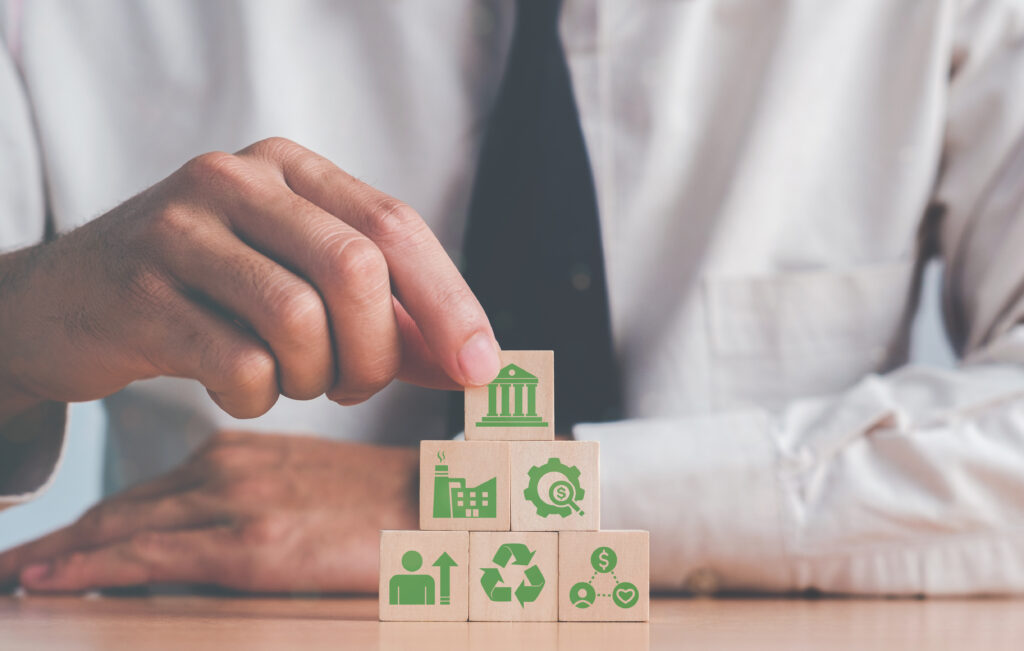
What does sustainability mean in corporate governance? How can you act in the most future-proof way possible and avoid sustainability risks? And what role do digitalisation and AI play in this? We have already highlighted some of the prerequisites such as a sense of purpose or authenticity in the Valdivia Newsroom. Especially in the current difficult market situation in the construction and property industry, we would like to direct your attention towards the future with this article: There are many opportunities and positive impulses in the idea of sustainable management, from which fresh energy can be gained.
Sustainable corporate management: focussing on responsibility and risks
Securing the future of your own company with foresight and for the long term has always been a core task of managers. Today, another factor is increasingly being added to this: responsibility towards society and the environment. Sustainable behaviour — and therefore also the avoidance of sustainability risks — requires a new way of thinking. Economic success alone no longer ensures continued existence; attention must now also be paid to compatible interaction with the social and physical environment.
This interaction can be clearly seen in the intentions of the EU’s Corporate Sustainability Reporting Directive CSRD. For the time being, it only applies to large companies and corporations, but its core idea appeals to everyone: Companies should be aware of the social and environmental risks associated with their actions. These can be external risks such as demographic or climate change. However, the consequences of their own actions for stakeholders, the environment and society should also be considered and reduced.
Sustainable management: realisation in 6 “trades”
- Goals and strategies
Firstly, the foundation: define the global purpose, objectives (vision) and strategy (mission) of your company — preferably together with employees at different levels. Sustainability should be firmly anchored in this as a core criterion for all decisions and processes.
- Transparency and participation
Inspiring and instilling trust is one of the most important instruments of sustainable leadership. The best way to achieve this is to be open about your goals and plans. To this end, you should involve all stakeholders as far as possible — including shareholders, customers, freelance employees and, if necessary, the public. In addition to round tables and working groups, online panels and surveys are a good way to ensure efficient implementation.
- Advantages and incentives
Sustainability ultimately benefits everyone, but the transformation often meets with reservations. The best way is therefore to emphasise the desired benefits as clearly as possible and create positive incentives; the participation mentioned under 2. can be such an incentive, for example. A recent Deloitte study1points out an important point: Effective motivation takes individual perceptions and desires into account. The study recommends data-based analyses in order to understand what really motivates people and to align the selection of incentives accordingly.
- People and work
One building block for sustainability is job stability — something that 96% of employees prioritise according to an iwd study2. At the same time, flexibility is required today: fixed job profiles and career paths are no longer enough. Instead, the Deloitte study recommends dynamic teams and individual working models based on personal strengths — an approach that 92% of employees would also like to see2. Possible implementations range from New Work models and training programmes to the streamlining of work processes in order to create scope for creativity and productivity.
- Environment and climate
Environmental compatibility and climate protection also improve your chances on the labour market: according to a recent survey by the ManpowerGroup, 60% of employees already prefer companies with a positive environmental profile, and in the younger “Generation Z” even 75%3. Start with ideas that are easy to implement and quickly achieve significant effects — for example, public transport tickets and company bicycles, building materials and craft businesses from the region or recycled furniture for staging of your properties for sale. Rapid, positive changes are an experience that provides lasting motivation.
- Resources and controlling
Sustainability transformation fails more often due to a lack of budget than good will. Sustainable management should orientate its projects less towards large initial steps, preferring instead to set up smaller projects that are solidly financed in terms of follow-up costs. Finally, monitoring is also part of the process: Reporting helps to check the progress of quantifiable measures. Employee surveys show whether incentives are really being received. Market research allows you to check whether your sustainability strategy is credible and targeted.
Sustainability and digitalisation: strongest together
In many companies, digitalisation is on the agenda alongside sustainability. However, this is not a competition. On the contrary, digital transformation is ideally suited to supporting and strengthening sustainable action. With the help of artificial intelligence in particular, both transformation processes can be optimised together.
Sustainable leadership should always consider the perspective of employees when using AI. A transparent approach, open test access and exciting lighthouse projects can strengthen the acceptance of AI and counter the fear of job losses. A “human value proposition” could serve as a basis — a guiding principle that defines the use of AI in the company to give employees more freedom and opportunities for meaningful activities.
Sustainable leadership: Leading into the future
Today, corporate management has to navigate between economic requirements, technological transformation and employee expectations. However, the Deloitte study shows that companies are more successful in the long term if they actively accept the challenges and balance tensions in a targeted manner — in other words, if they
- offer stability without sacrificing agility and innovation;
- grant employees as much autonomy as they need to be productive;
- Identifying starting points where AI should relieve employees and where it should expand their opportunities.
However, sustainable leadership today also means stepping back. Because what is needed is no longer the classic sole decision-maker and supervisor, but leadership that supports, develops and trusts. This requires a deep understanding of how economic and human factors are interwoven. Future-proof, sustainable leadership therefore means combining technology, organisation and human potential in such a way that a long-term, sustainable foundation is created — for companies, society and the environment.
Sources
- “Human Capital Trends 2025 — Turning Tensions into Triumphs: Helping Leaders Transform Uncertainty into Opportunity”, Deloitte, March 2025
- “What makes employers attractive”, Institut der deutschen Wirtschaft iwd, October 2024
- “A People First Green Business Transformation”, ManpowerGroup Report, August 2024
(Image source: istockphotos)