How can companies in the real estate sector distinguish themselves in today’s market and thus gain a competitive edge?
One way to achieve this is by expanding their existing core business through additional offerings, service models, subsidiaries or partnerships. This opens up new opportunities for additional revenue and value creation, as well as new, distinctive positioning and marketing avenues without compromising the brand’s core values or price levels. In this Valdivia Newsroom edition, we use concrete examples to show you how property companies can make targeted use of their existing strengths to tap into new business areas. Identify these ‘goldfields’ for your company – and with them, the opportunities for long-term growth and a stronger market position.
Vacancies – the typical “goldfield”
The fields of activity within the construction and property sector are diverse – ranging from familiar ones such as greenfield and brownfield sites to relatively new concepts like bluefield, which incorporates bodies of water. We refer to new business areas with attractive growth and value-creation potential as ‘goldfields’. A key characteristic is that they are derived from existing properties, expertise or processes and can therefore be developed with comparatively low risk.
Typical examples include the diverse possibilities for revitalising outdated or vacant office buildings, or the conversion of hotels to cater for the growing popularity of workation stays, which we have previously reported on in earlier issues. Furthermore, leasing or letting these properties allows for predictable long-term income whilst keeping the buildings within the portfolio.
Added value from ecosystems
However, developing innovative, demand-driven properties from existing stock is only one aspect of ‘goldfields’. Their general advantage for construction firms, project developers or investors lies in opening up new, demand-driven business areas that are nevertheless linked to existing core competencies and assets.
Goldfields can thus serve as the starting point for a wide variety of property-related services – ranging from property search and financing to local energy supply and the development of AI-supported services relating to buildings and their use. Goldfields emerge where various services are intelligently combined into an ecosystem that opens up new markets and extends the value chain.
Deriving greater value from existing expertise
- Holistic office fit-out
As studies show1, companies and their employees today want offices with varied designs, different work zones and services ranging from a barista to a crèche. Architecture and fit-out should support flexible teamwork and, as a counterbalance to the advantages of working from home, provide a stimulating atmosphere. Some construction firms have recognised this and reinvented themselves as concept providers. They offer holistic services covering planning, fit-out, interior design and furniture – individually tailored to each client and with the aim of designing offices as oases of well-being that promote both performance and quality of life in equal measure.
- Green Transformation
Another goldmine lies in reducing the environmental footprint of existing buildings. In addition to energy-efficient refurbishment, this includes the use of environmentally friendly technologies and processes, as well as sustainable building materials. The design and installation of additional green roofs and green façades could also expand the range of services on offer and open up new marketing opportunities.
- Energy generation and distribution
The energy transition also opens up new opportunities for construction and property companies, building on existing resources and expertise. In addition to investments in the expansion of regional and local electricity grids – for example, via project companies or energy transition funds – energy generation on their own properties offers particularly attractive potential. Photovoltaic systems on residential and commercial properties create additional sources of income, for example through models such as tenant-generated electricity. Those who make strategic use of land, capital or their property portfolio can expand their business model in this area whilst simultaneously positioning themselves as promoters of the energy transition.
Services – a goldmine of opportunities
Services relating to the financing, development, construction and operation of properties are a goldmine of opportunities. Many solutions in this area can be implemented digitally with relatively little effort. Artificial intelligence also enables small and medium-sized enterprises to develop innovative, high-performance value-added services with manageable effort. Even in the event of a change of ownership – much like when buying a car – buildings and services tailored to them can be offered as a package, thereby securing additional, long-term revenue.
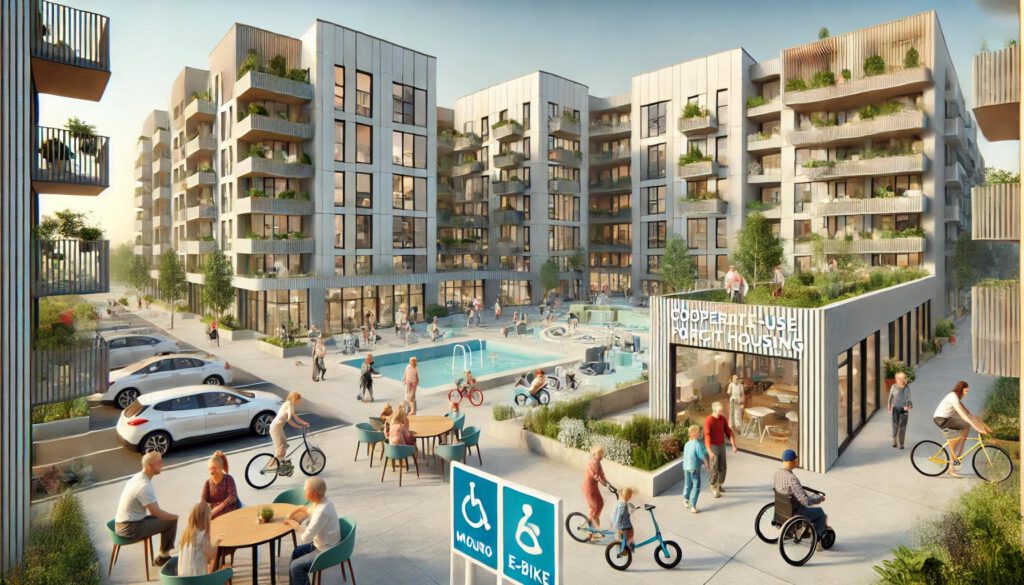
Another way for developers and owners to expand their range of services is through community management for neighbourhoods or business parks. With this approach, dedicated contact persons, proactive communication and community-building initiatives create tangible added value for residents, employees and owners alike. The result is a stronger sense of connection to the neighbourhood or business, greater trust and higher levels of satisfaction. Practical experience shows significant improvements in service quality, response times and tenant satisfaction. As a complementary service offering, community management thus becomes a compelling differentiating factor and an additional selling point.
Expansion into the digital world
AI-supported systems can ease the burden on property management teams, facility management and owners, particularly when it comes to property-specific communication with tenants in residential properties, employees in commercial properties and within the private property market. At the same time, they open up new business areas by utilising existing properties, data and customer relationships to provide additional digital services. A wide range of such solutions can be developed by combining chatbots, voice bots, databases and selected interfaces.
The potential applications range from financing and refurbishment, through building usage, to property valuation: a ‘construction finance adviser’ can provide support during the preparation and throughout the process of securing construction finance. A ‘renovation adviser’ supports owners and tenants with energy-efficiency refurbishments, listed building regulations or age-appropriate housing. An ‘OurOffice app’ brings together tips for lunch breaks, damage reports and community features. A ‘property valuation app’ provides owners and prospective buyers with information on current valuations, location, market trends and price developments.
Furthermore, such applications can simplify the search for trusted advisers, service providers or tradespeople and, through reviews and the experiences of other users, offer guidance in making a choice. In this way, existing property relationships give rise to digital value-added services that expand the range of services on offer, tap into additional sources of revenue and strengthen customer loyalty.
Conclusion
Whether as an extension of their own core offering, as a subsidiary or through partnerships – for construction and property companies, tapping into ‘goldfields’ can mean growth or even securing their very survival.
Many of these ‘goldfields’ do not lie in the development or construction of a property, but in its subsequent use. This brings the entire life cycle into focus as a source of additional services and value creation. In this way, a property evolves from a completed project into the foundation for long-term customer relationships, further services and follow-up contracts.
The starting point should be a company’s own assets and core competencies, but beyond that, there are virtually no limits to creativity. Specialisations, specialist niches and the targeted use of AI offer countless opportunities to stand out from the competition and tap into new sources of revenue. In this way, existing resources act as a goldmine from which new value is created and promising business areas for the future emerge.
Sources
- “Future Office: What will make offices attractive in the future?”, Fraunhofer Institute for Industrial Engineering IAO / Union Investment, February 2025
(Image source: istockphotos.com)