Sustainable properties have been proven to offer good asset values and rental income. But how can the planting of outdoor areas increase this effect and thus their attractiveness on the market? In the current issue of the Valdivia Newsroom, we look at the possibilities of using an “XXGreen concept” not only to strengthen climate protection and sustainability, but also to increase the quality of use and value of properties. As with the dingbats and office vacancies, this time the focus of our property marketing tips is on the product itself.
Green building: opportunities and hurdles
What is the current status of “green building”? Approaches such as the Heating Act, passive houses and building with wood point in the right direction. Nevertheless, the overall development still seems rather restrained1:
- In 2024, sustainability still generated a slight increase in demand and positive value development. Overall, however, this factor did not play the expected, overriding role in the valuation and returns of property and construction projects.
- The study participants cited the high initial costs for sustainable construction and the corresponding materials as the biggest hurdles. Another obstacle is the lack of suitable specialists and qualifications, followed by a lack of or obstructive legal framework conditions.
Green added value, brown discount
There are still many good reasons for investing in “green property”. After all, they not only help protect the climate. A study2by ImmoScout24 and the Bundesverband energieeffiziente Gebäudehülle e.V. (BuVEG) from 2022 shows that energy-efficient buildings are also particularly profitable:
- Properties with low energy consumption achieved on average 22 % higher sales prices than comparable properties with poor building envelopes. At the peak, prices were up to 35 % higher.
- Energy-efficient properties in two age categories achieved particularly good comparative values: Old buildings built up to 1949 with a 25 % higher value and new buildings from 1991 to 2018 with a 23 % higher value.
The study analysed 155,000 residential properties and compared them according to location (city, surrounding area, rural region) and building age categories. “Energy-efficiently modernised buildings are not only crucial for significantly more climate protection. They are a key factor in increasing the value of a property,” said Jan Peter Hinrichs, Managing Director of BuVEG, summarising the results
The aforementioned RICS study1comes to similar conclusions: almost half of the participants estimate the added value of sustainable buildings to be higher than that of comparable, non-sustainable properties; according to 44%, the same applies to corresponding rental income. It is also worth noting that around a third of participants do not charge a premium for sustainability, but estimate a “brown discount” on value or rents for non-sustainable properties.
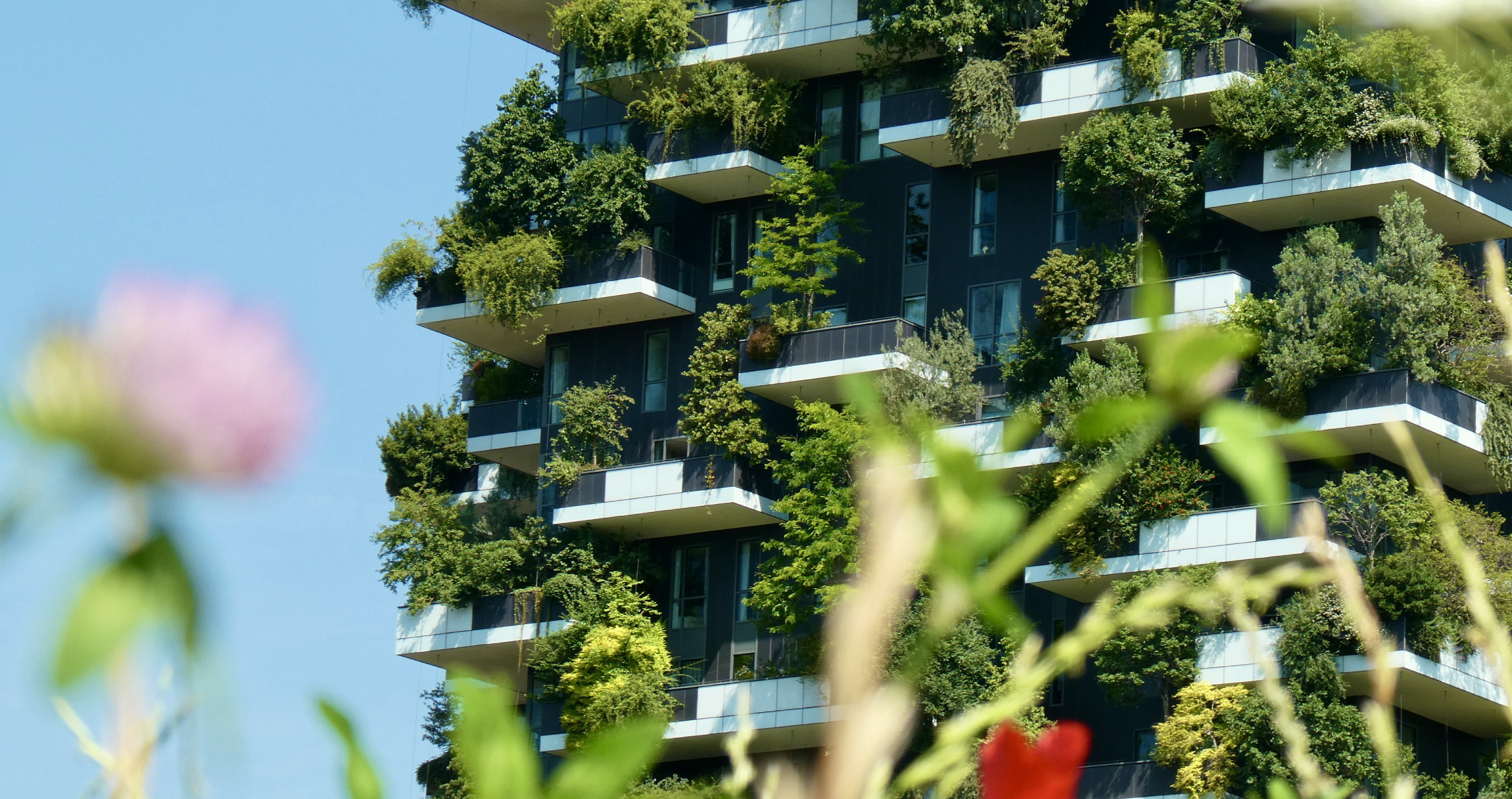
Blooming views in the vertical garden
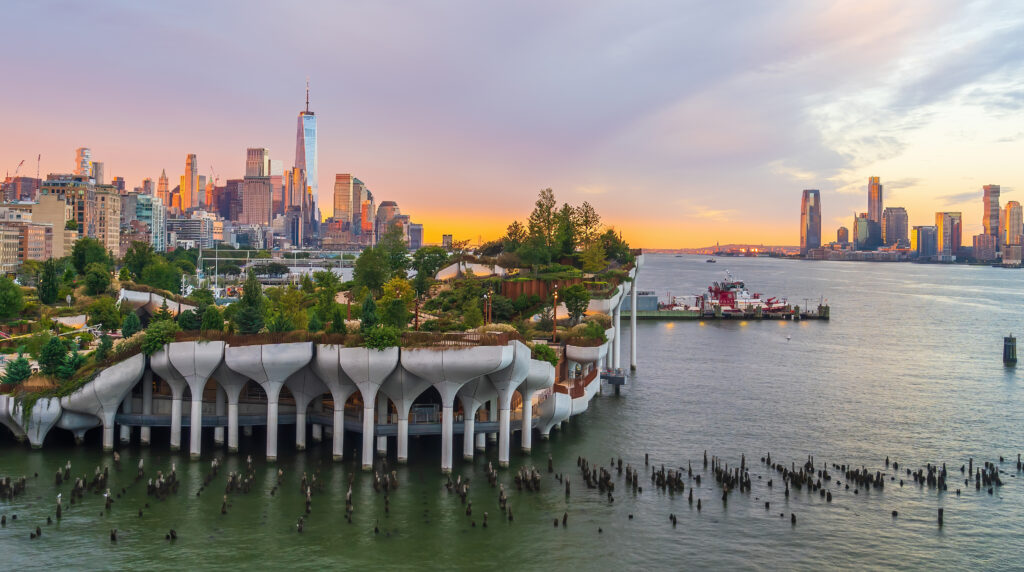
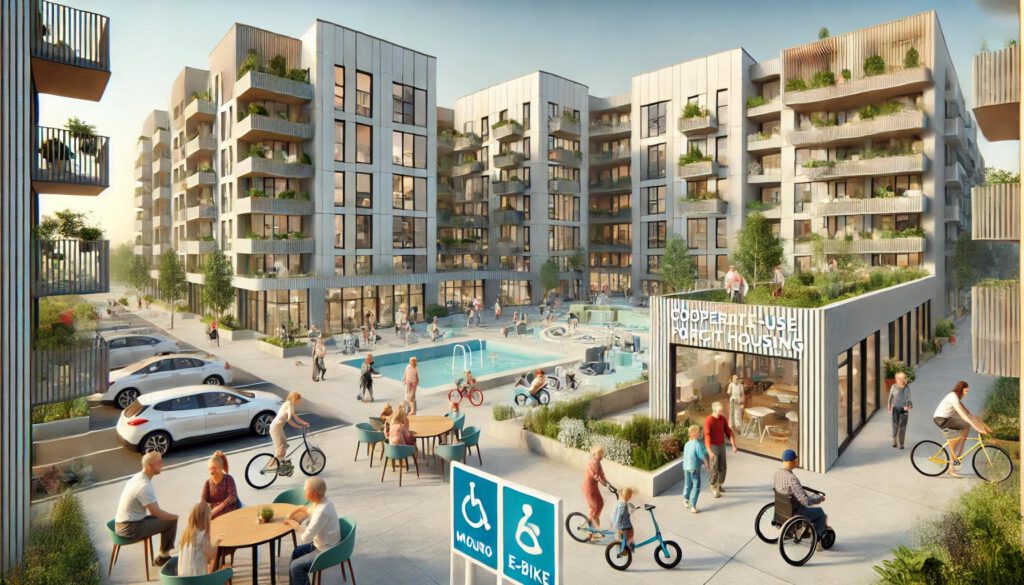
A new dimension of sustainability arises from the idea of planting roofs and — particularly striking — façades. This external greening complements properties that are already designed to be sustainable to create an “XXGreen property” — with numerous monetary benefits(3) (/) (4):
- as an architectural enhancement, e.g. by visually highlighting parts of the façade, to structure or individualise the building and to create natural spaces for balconies and loggias;
- as additional thermal insulation at high and low outside temperatures and by reducing wind cooling;
- as noise protection, rainwater storage and by improving biodiversity;
- as a natural protective shield against driving rain, hail and UV radiation;
- as a biophilic factor for a better quality of life and well-being through to physiological effects such as lowering blood pressure and reducing stress for users.
XXGreen not only increases the value of the building and optimises the energy and operating cost balance, but also gives the property an attractive, sustainable image. The marketing of the property in particular benefits from the positive image of a “vertical garden”. Although there are still too few such buildings for direct comparisons, a Dutch study5is already showing promising results: Green exterior facades on shops attract more customers and can increase sales by up to 12%
How your opportunities grow with XXGreen
The large-scale greening of roofs and façades is a valuable investment in the future of a property that pays off in the long term with numerous benefits. Initially, a certain amount of additional work is required — for example, for suitable containers, a water supply for dry periods and a budget for regular green maintenance. A new, root-resistant exterior render may have to be applied to existing buildings in order to optimally protect the building fabric. However, there are already projects that are specifically researching cost-effective solutions for this, such as the one by Frankfurt-based DGJ Architektur for the “WohnWerk Mannheim eG” cooperative, described in issue 1.2024 of “Quartier” magazine.
Exterior greening should also not be used as a “fig leaf” for greenwashing. An XXGreen concept can only be effective as a marketing and price argument if the property is demonstrably energy-efficient and sustainable. However, if the visual appearance and figures are right, the combination of a sustainable building and creative greening offers good marketing opportunities even in difficult markets.
List of sources
- “RICS sustainability report 2024”, Royal Institution of Chartered Surveyors (RICS), London 2024
- “Increases in prices and demand for energy-efficient properties in Germany in 2022”, ImmobilienScout24 on behalf of the Bundesverband energieeffiziente Gebäudehülle e.V. (BuVEG), Berlin 2022
- “Facade greening in city centres — approaches for Karlsruhe in an international comparison”, Lilian Spannagel (Karlsruhe University of Education, Institute of Biology and School Garden Development), Karlsruhe 2021
- “Potentials of building envelopes to reduce heat generation and improve air quality in an urban context”, Fraunhofer Institute for Building Physics IBP on behalf of the German Federal Association for Energy-Efficient Building Envelopes (BuVEG), Stuttgart 2017
- “Groene winkelgebieden goed voor mens, natuur, klimaat en economie” (Green shopping areas good for people, nature, climate and the economy), Koninklijke Vereniging van Hoveniers en Groenvoorzieners (VHG), 2020
(Image source: istockphotos)