With the VALDIVIA MediaClub, we introduce films, documentaries, books, and other media that offer valuable perspectives on leadership, strategy, and organisational development.
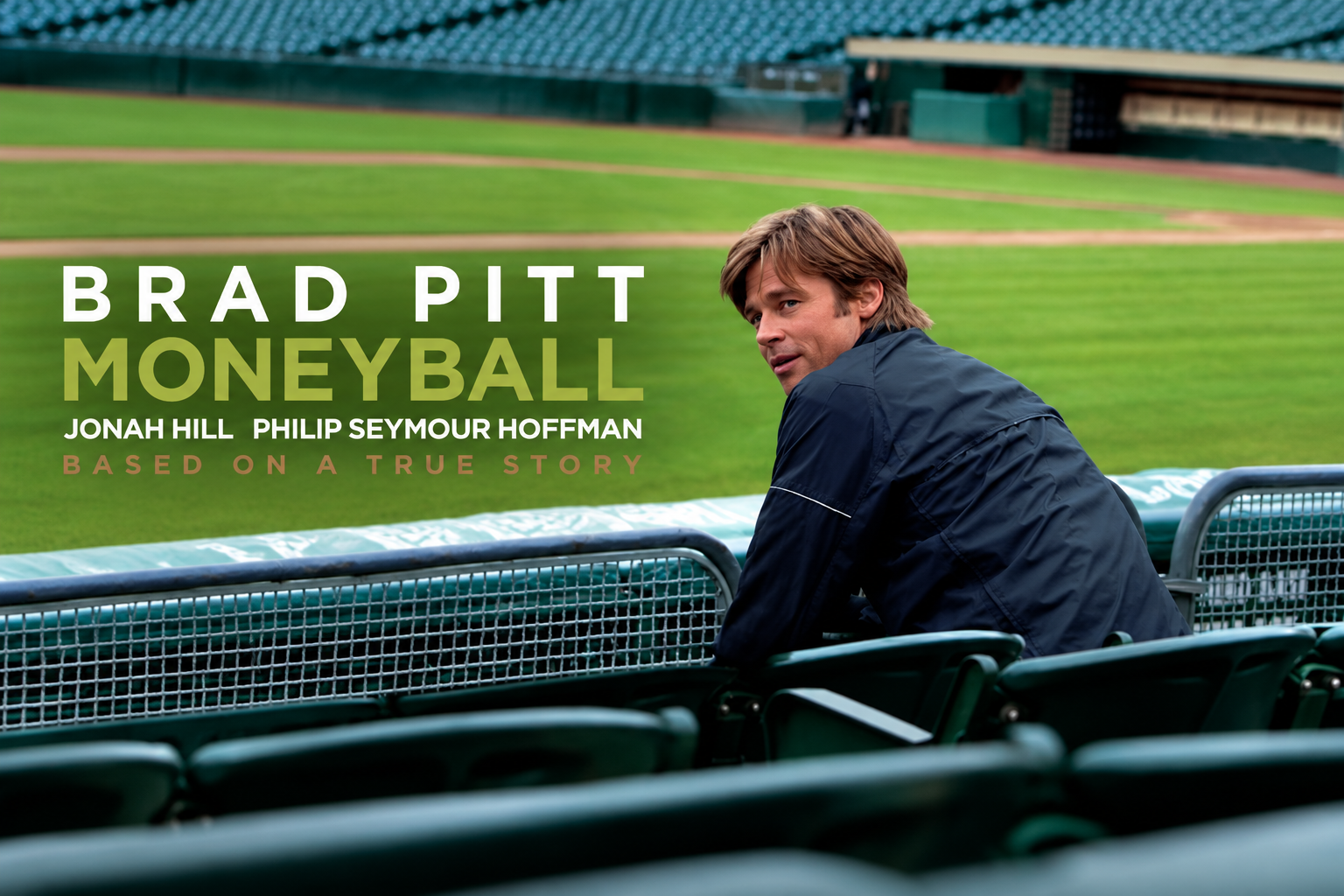
Today, we turn our attention to Moneyball: The Art of Winning an Unfair Game (2011), directed by Bennett Miller and based on Michael Lewis’s bestselling book. The film tells the story of a remarkable transformation in professional baseball while exploring a question that extends far beyond sport:
How can organisations create competitive advantage when resources are limited and established market rules appear to leave little room for success?
Competition Under Unequal Conditions
In the early 2000s, the Oakland Athletics faced a difficult reality. Competing against clubs with significantly larger budgets, they were unable to retain many of their best players and had little chance of matching their rivals financially.
General Manager Billy Beane, portrayed by Brad Pitt, recognised that simply copying the methods of wealthier competitors would not be enough. Together with analyst Peter Brand, he developed an alternative approach based on statistical analysis rather than traditional scouting opinions and reputations.
Their objective was to identify players whose contribution to success was measurable but systematically undervalued by the market. The principle was straightforward: if everyone evaluates talent in the same way, inefficiencies and mispricing are likely to exist. Those who identify them first can gain an advantage.
Strategic Advantage Through a Different Understanding of Value
One of the film’s most valuable lessons concerns the way value is defined.
Traditional baseball heavily favoured certain player attributes, such as physical characteristics, experience, and conventional performance indicators. Beane’s team challenged these assumptions and focused instead on the factors that genuinely influenced results.
The lesson for business is clear: competitive advantage does not arise solely from superior resources. It can also emerge from seeing value differently and allocating resources more effectively than competitors. Organisations do not always need the largest budgets, strongest brands, or deepest talent pools. In many situations, success depends on understanding market dynamics more accurately and making different decisions as a result.
Moneyball illustrates how strategic differentiation can emerge from a fundamentally different understanding of value creation.
Why Established Organisations Resist Change
The film also highlights an issue familiar to many business leaders: resistance to change. Beane’s data-driven approach was initially met with considerable scepticism from experienced scouts and decision-makers whose expertise had been built on long-established methods.
This tension reflects a broader organisational reality. Successful routines create stability, but they can also limit adaptability. The challenge becomes even greater when new insights do not simply refine existing processes but question the foundations of accepted expertise.
Moneyball reminds us that strategic transformation requires more than new tools or technologies. It requires leaders willing to challenge assumptions and act on insights despite internal resistance.
Data-Driven Decisions as a Leadership Responsibility
Moneyball is often celebrated as a triumph of analytics, yet the film demonstrates that data alone does not create success. Data can reveal patterns, test assumptions, and highlight opportunities. The difficult part remains human: interpreting insights, accepting calculated risks, and implementing change.
This message feels particularly relevant in today’s age of artificial intelligence and advanced analytics. While organisations have access to more information than ever before, competitive advantage still depends on their ability to convert information into decisions and decisions into action. Data literacy and leadership capability are therefore not alternatives. They are complements.
What Moneyball Teaches Us About Business Leadership
For executives and entrepreneurs, the film offers several enduring lessons:
- Limited resources do not automatically create a lasting disadvantage.
- Established assumptions and performance metrics should be challenged regularly.
- Analytical insights create value only when they are translated into action.
- Strategic innovation often faces uncertainty and resistance before producing results.
Perhaps most importantly, the film demonstrates that successful strategy is not always about becoming incrementally better within existing rules. Sometimes the real opportunity lies in questioning the rules themselves.
A Compelling Example with Important Limitations
One of the film’s greatest strengths is its ability to make complex strategic concepts accessible through a clear and engaging story.
It combines resource constraints, analytical decision-making, and organisational change into a compelling example of how established competitive logic can be challenged.
At the same time, a balanced perspective is important. The film condenses historical events for dramatic effect and simplifies certain aspects of the story. Furthermore, a team’s success cannot be attributed solely to a single analytical model.
From a strategic standpoint, identifying overlooked resources does not automatically create a sustainable competitive advantage. Once competitors adopt a successful approach, the original advantage may diminish or disappear.
This distinction is what makes Moneyball especially relevant for strategic discussions. It demonstrates how new opportunities can be discovered while leaving open the important question of how such advantages can be defended over the long term.
Beyond Performance Metrics: Building Value Rather Than Chasing Results
An interesting parallel can be drawn from a perspective shared by James Wakefield, Executive Chair of Cobalt Recruitment, in his article “Are You Building a Valuable Business or Simply Outperforming Your xG?”
Using football’s Expected Goals (xG) concept, Wakefield argues that organisations can sometimes achieve strong results despite underlying weaknesses, while others may temporarily underperform despite building stronger foundations for future success. The question, therefore, is not simply whether an organisation is winning today, but whether it is creating sustainable value for tomorrow.
This perspective aligns closely with the central message of Moneyball. Billy Beane’s achievement was not merely about winning more games. It was about identifying assets the market had undervalued and recognising sources of value that others overlooked.
For business leaders, this distinction is critical. Short-term performance, rapid growth, or impressive quarterly results do not necessarily indicate a durable competitive position. Investments in talent, culture, capabilities, strategic focus, and data-driven decision-making frequently create value long before the results become visible.
Both Moneyball and Wakefield’s xG analogy ultimately point to the same conclusion:
Sustainable competitive advantage emerges when organisations recognise and develop sources of value before they become obvious to everyone else.
Our Verdict
Moneyball: The Art of Winning an Unfair Game is highly recommended for leaders, entrepreneurs, and decision-makers interested in strategy, innovation, and organisational transformation. The film demonstrates that successful strategy is not always about becoming more efficient within existing competitive conditions. Sometimes the decisive advantage comes from questioning the underlying assumptions of a market and discovering entirely new ways of competing.
Particularly valuable is the connection between analytical insight and entrepreneurial execution. Even the most convincing data does not automatically produce better outcomes. Real strategic opportunity emerges only when organisations are willing to challenge established thinking and translate new insights into action.
Our key takeaway:
Competitive advantage does not arise only from having better resources. It often comes from understanding the value of those resources better than your competitors.
Sources
Moneyball: The Art of Winning an Unfair Game
Director: Bennett Miller, Based on the book Moneyball: The Art of Winning an Unfair Game by Michael Lewis, Studio: Columbia Pictures, Release Year: 2011, Running Time: 133 minutes
Further Reading
Are You Building a Valuable Business or Simply Outperforming Your xG? James Wakefield, Executive Chair, Cobalt Recruitment.
(Image: AI adapted)